Showing posts with label Sierra Leone. Show all posts

Monday, December 1, 2014

How will we know when the number of Ebola infections starts to decline?


According to the World Health Organization (WHO), three West African countries continue to experience intense transmission of Ebola. More than 16,000 cases of Ebola have been reported from Guinea, Liberia, and Sierra Leone in the past several months since the outbreak started earlier this year (link). There is some evidence that the rate of new Ebola infections in these countries is not growing as fast as previously estimated which is good news. The WHO situation report published on November 26, 2014 (link) states “Case incidence is stable in Guinea, stable or declining in Liberia, but may still be increasing in Sierra Leone”.

However, there is great uncertainty over the quality of the reporting data emanating from West Africa on this Ebola outbreak. Also, based on the fluctuating numbers of newly reported cases in each of these three countries, it is difficult to assess the increases or decreases in the incidence of cases in these three countries. Assuming that the case numbers reported in the WHO situation reports are representative the number of infections in each of these countries, the average number of new cases per day can be graphed on a timeline. Below, the average number of new cases per day is compared with the cumulative moving average of cases since the start of the outbreak within each of the three countries.

These graphs clearly show that the trajectory of the number of new cases in each country generally support the WHO statement. At this time, the number of new  daily cases  in Guinea appears to be declining towards the cumulative moving average. Recent new case counts for Liberia have fallen below the long term cumulative moving average. For Sierra Leone, the reported average number of Ebola cases is above the cumulative moving average,  This is a clear indication that rate of Ebola infections in Sierra Leone have not yet started to decline.

Eventually, declines in the number of new Ebola infections in these three countries will only be apparent when the daily average of newly reported Ebola cases drops below-and stays below-the cumulative moving average. At that time the cumulative moving average will begin to decline as well. Comparing the number of daily new cases in these countries in relation to the cumulative moving daily average will help identify when there is a downturn in the number of new Ebola infections in these countries. 


Graph Notes:

1. Data used to construct these graphs is derived from the country totals provided by WHO in the Ebola situation and data updates current through November 28, 2014 (link). The new daily cases counts includes all Ebola cases reported from the country including, confirmed, probable, and suspected cases.

2. The average number of new Ebola cases per days is computed as the total number of newly reported cases since the last report divided by the number of reporting days. The average number of new cases per day is recalculated after each WHO report.

Wednesday, October 15, 2014

Comparing WHO and CDC Projections of Ebola Cases in the Future


Through October  12, 2014, the World Health Organization  (WHO) has reported more than  8900 cases of Ebola since this epidemic began  (link).  The outbreak is currently out of control in three countries in West Africa, Guinea, Liberia, and Sierra Leone.  The graph below depicts the timeline of the growth of the  cumulative number of total cases reported by  each of these countries.  


The overall cumulative Ebola case total time series can be fitted to an exponential growth curve to project the total number of cases going into the future. The WHO data indicate that by January  2015 there will be almost 45,000 Ebola cases as shown in the graph below.


There is no doubt now that this outbreak will not be contained in West Africa by the end of December.  How many future cases of Ebola will there be is difficult to predict. WHO has noted on several occasions that the officially reported numbers under represent the actual number of cases and deaths in these countries.

On the other hand,  The US Center for Disease Control  (CDC) has projected cases counts ranging from 550,000 to 1.4 million cases in Sierra Leone and Liberia by mid January 2015 (link).  The CDC adjusted  existing case counts by a factor of 2.5 according to their model (as of August 28, 2014).  The graph below compares the differential growth rates based on current WHO data and the estimated case count by the CDC.  According to the CDC estimates, there are now at least 22,000 Ebola cases in West Africa compared to the 8900 reported by WHO.

The graph indicates the clear disparity in the different estimates by these two health agencies of the future case count of Ebola.  As we edge closer to the end of 2014 we will have a better idea of which projection is more accurate.

Where does the WHO estimate of 5,000 to 10,000 new Ebola cases in December come from?


The number of Ebola infections in West Africa continues to increase at an alarming rate (link).

As the official international public health agency, the World Health Organization (WHO) is tasked with tracking and reporting on infectious diseases around  the world.  As of October  14, 2014 the WHO has reported more than 8900 Ebola cases from the three West Africa nations of Guinea, Liberia, and Sierra Leone, where the Ebola outbreak has not yet been contained (link).

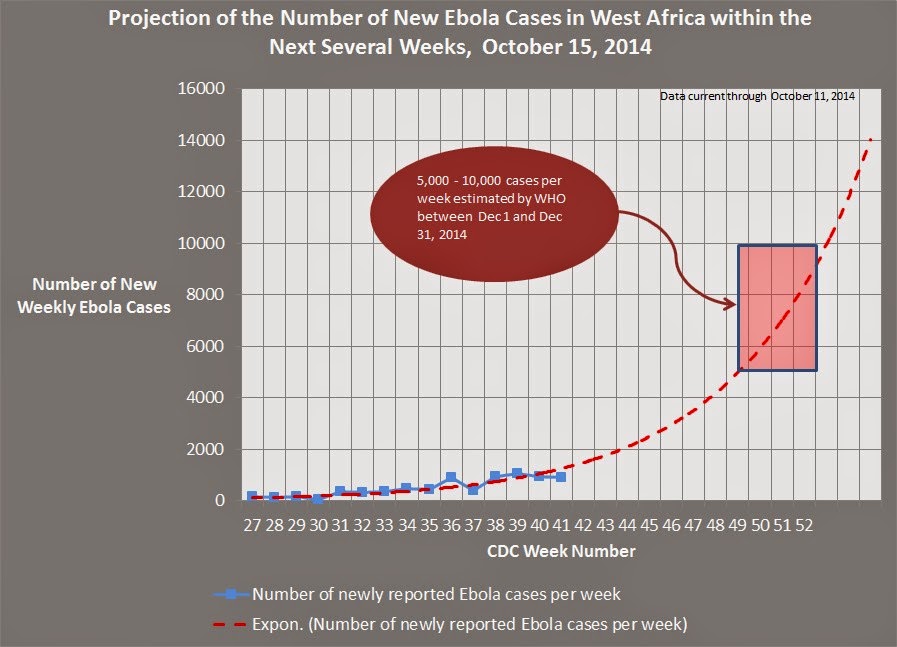
Below is a chart showing the continued rising number of new cases by week number in these three countries.  The data in the chart is based on official WHO data through October 12, 2014 (link).  A quote from Dr. Bruce Aylward,  a WHO spokespersonindicates that by mid December 2014 between 5,000 to 10,000 new weekly Ebola cases could reported in the three West African countries  (link).

The next graph below shows the temporal progression of the increases in new cases with a trend line projecting news cases into the coming weeks. The exponential trend line from the current  WHO data projects 5,000 to 10,000 new weekly cases of Ebola in West Africa by December 2014. This is the basis of Aylward's comments yesterday.


Tuesday, September 16, 2014

Ebola infections continue to grow in West Africa

The Ebola epidemic in the three West African countries of Guinea, Liberia, and Sierra Leone continues to grow. As depicted in the graph below,  there have been erratic increases in the number of new Ebola cases in these counties since week number 20 (starting May 11, 2014).


The next graph below, based on the average number of new Ebola cases per week, indicates that the longer term statistical trend in the number of cases is continued exponential increase. The variability in case data from these three countries for week numbers 37 and 38 suggests that local public health officials in these countries can no longer accurately track and count Ebola cases.  Without international support there is no reason to expect that the infection rate will decline any time soon in these countries.


Graph notes: The data used in this graph are derived from World Health Organization and are current through September 16, 2014.  Only cases from the Ebola outbreak in Guinea, Liberia, and Sierra Leone are used in this graph.

Thursday, September 4, 2014

Ebola infections in West Africa continue to grow

In a previous post (Ebola is not yet under control in any West African country), I criticized an article that suggested that Ebola infections were declining in several countries in West Africa because the effective reproductive rate was less than 1. 

The graph below depicts the number of new weekly infections in the three West African countries (Guinea, Liberia, and Sierra Leone).  Cumulatively, the number of Ebola infections is continuing to grow. The World Health Organization has indicated today (link) that these countries have widespread intense transmission of Ebola. 


Graph notes: The data used in this graph are derived from World Health Organization and are current through August 31, 2014. Graph notes: Only cases from the Ebola outbreak in Guinea, Liberia, and Sierra Leone are used in this graph. The cases from Nigeria are not included in the week totals, but would not appreciably affect the projected rate of growth of new cases. All data are from WHO.

Tuesday, September 2, 2014

Ebola is not yet under control in any West African country


In a recent article entitled Estimating the reproduction number of Ebola virus (EBOV) during the 2014 outbreak in West Africa, Christian L. Althaus, a post-doctoral research fellow at Institute of Social and Preventive Medicine at the University of Bern, provides an optimistic and unrealistic assessment of the Ebola outbreak in West Africa. In the abstract, Althaus implies that the Ebola outbreaks in Guinea and Sierra Leone were under control by the end of May and July 2014, respectively. Elsewhere in the text he contradicts the abstract and states:
"This results in a different decrease of the effective reproduction number, Re, after the outbreaks started in each country [Guinea. Liberia, Sierra Leone]. While Re dropped below unity in Guinea and Sierra Leone by end-August 2014, the model suggests that control interventions were not successful in reducing Re in Liberia."
Based on the World Health Organization (WHO) comments that the number of Ebola cases are grossly underestimated (WHO link, WHO link), there is no evidence to suggest that as of September 1, 2014 the effective reproductive rate has dropped below 1 in either Guinea or Liberia nor is there evidence of a concomitant decrease in new cases.

Althaus also states:
"In particular, I assumed that the transmission rate decays exponentially due to control measures after the appearance of the first infectious case."
With more than 240 health care workers infected during this outbreak (WHO link) and health care facilities overwhelmed, there is no reason to assume that adequate control measures are in place. Without adequate control measures, transmission rates will not decrease exponentially in these countries in the near future and the current data do not suggest that the reproductive number in any of these countries is less than 1. At this time, the Ebola outbreak in West Africa is continuing to grow and is not yet under control.

Friday, August 29, 2014

Current Geographic Distribution and Status of Ebola in African Countries, August 29, 2014


As of August 29, 2014, six countries from Africa are currently reporting confirmed Ebola cases. See map below.

Democratic Republic of the Congo
The DRC has reported a Zaire ebolaovirus outbreak in province unrelated outbreak in West Africa. Forty-two confirmed, probable, and suspected Ebola cases have been reported. link
Situation: currently under control

Guinea
According to the World Health Organization (WHO) on August 28, 2014, a minimum of 648 confirmed, probable, and suspected cases of Ebola have been reported from Guinea. link
Situation: is not under control

Liberia

According to WHO as of August 28, 2014, a minimum of 1378 confirmed, probable, and suspected cases of Ebola have been reported from Liberia. link
Situation: is not under control

Nigeria
According to WHO as of August 28, 2014, 17 confirmed, probable, and suspected cases of Ebola have been reported from Nigeria. All appear to have been linked to one imported case from Liberia. link
Situation: currently under control

Senegal

As of August 29, 2014 Senegal has confirmed one imported case of Ebola. link
Situation: currently under control   

Sierra Leone
According to WHO as of August 28, 2014, a minimum of 1026 confirmed, probable, and suspected cases of Ebola have been reported from Sierra Leone. link
Situation: is not under control

Map note: Each of the six countries has reported at least one confirmed case. Case counts depicted on the map include confirmed, probable, and suspected cases.